

Match Rate Was Never the Point
Match rate is the most quoted number in identity.
It may also be the most misleading.
The appeal is easy to understand. Match rate is a single figure. It is simple to compare across vendors and easy to put in a presentation. But a match rate only tells you how many records were connected. It does not tell you how many of those connections are correct.
That distinction matters more than most buyers realize.
Match Rate and Precision Are Not the Same Thing
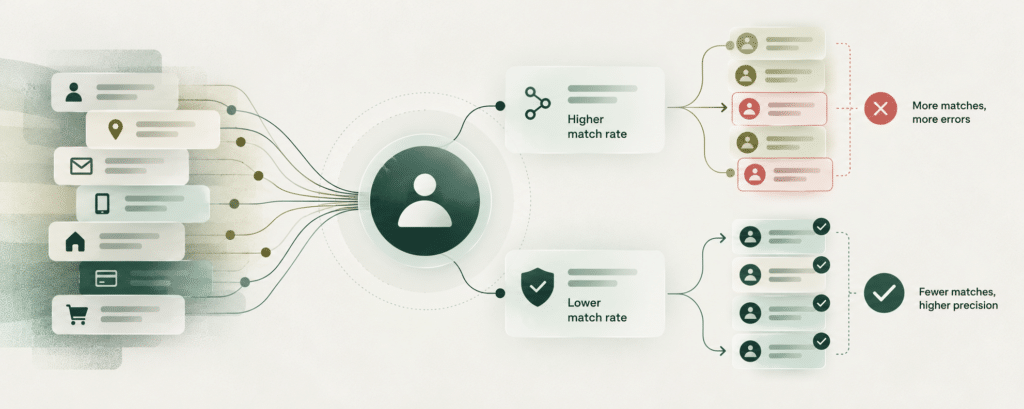
Match rate and identity precision can move in opposite directions.
The simplest way to increase a match rate is to loosen the matching rules. Accept weaker signals. Lower confidence thresholds. Connect records that are probably the same person.
Each of those choices increases the number of matches. Each of them also increases the number of false positives.
As a result, a vendor can report a higher match rate than a competitor while delivering a less accurate view of the customer. When evaluations focus on match rate alone, the less precise approach can look like the stronger one.
Identity Errors Distort Measurement
Identity errors are often described as a reach problem. Fewer matches mean fewer people to target.
The larger cost is less visible.
Recent research from LiveRamp and the MMA shows how identity precision can materially affect measured campaign ROI. When the wrong people are linked, conversions can be credited to exposures that never happened. Suppression lists can fail, so existing customers keep receiving acquisition offers. Models can learn from merged profiles that do not represent any real person. Budgets can shift toward channels that only appear efficient because the identity underneath is inflating results.
None of these problems trigger an alert.
They produce confident dashboards built on flawed inputs, and those dashboards shape real investment decisions.
A Better Question for Identity Buyers
The buyer question needs to change.
The question is no longer, “How many records did you match?”
It is, “How much error are those matches introducing?”
That question leads to more useful conversations. How is precision tested, and against what truth set? What does a match require? Is it based on a verified connection or a statistical likelihood? How often are linkages refreshed? Can a specific match be explained?
A partner confident in its precision should welcome those questions.
Certainty Creates a Stronger Foundation
Deterministic identity resolution starts from a different place. It links records based on verified connections rather than inferred likelihood, and it prioritizes certainty over volume.
In some cases, that may mean a lower headline match rate than a probabilistic approach. But the matches hold up. Attribution credits the right touchpoints. Suppression works as intended. Customer counts reflect real people. Measurement teams can stand behind their numbers when finance asks difficult questions.
Audience Acuity helps organizations build on that foundation, an approach that matters even more as AI agents start acting on identity data, through identity resolution, enrichment, profiling, activation, measurement, and attribution. Deterministic identity resolution gives downstream activation, measurement, and attribution a more reliable base, so the decisions built on top of identity reflect what actually happened.
Scale still matters.
But scale built on uncertain matches does not improve outcomes. It amplifies the errors.
The next time a match rate leads the conversation, ask about precision. The answer will reveal far more about what your measurement is built on.
 Identity Just Got a New Job: Why the Identity Layer Must Be Ready for AI Agents