


Closed systems are convenient. They are also becoming a liability.
As customer data spreads across warehouses, CRMs, clean rooms, media platforms, agency workflows, and measurement tools, marketers need infrastructure that can move with it, not lock it in. That is why composable customer infrastructure is becoming more important.
The recent Publicis/LiveRamp acquisition reinforces this larger market shift. Identity, data collaboration, activation, measurement, and AI-readiness are becoming more tightly connected. As that happens, brands need to think more carefully about the infrastructure behind their customer data strategy.
The question is no longer whether a platform can support a single use case. The question is whether the infrastructure can support the way modern enterprises actually operate.
Why Composable Architecture Matters
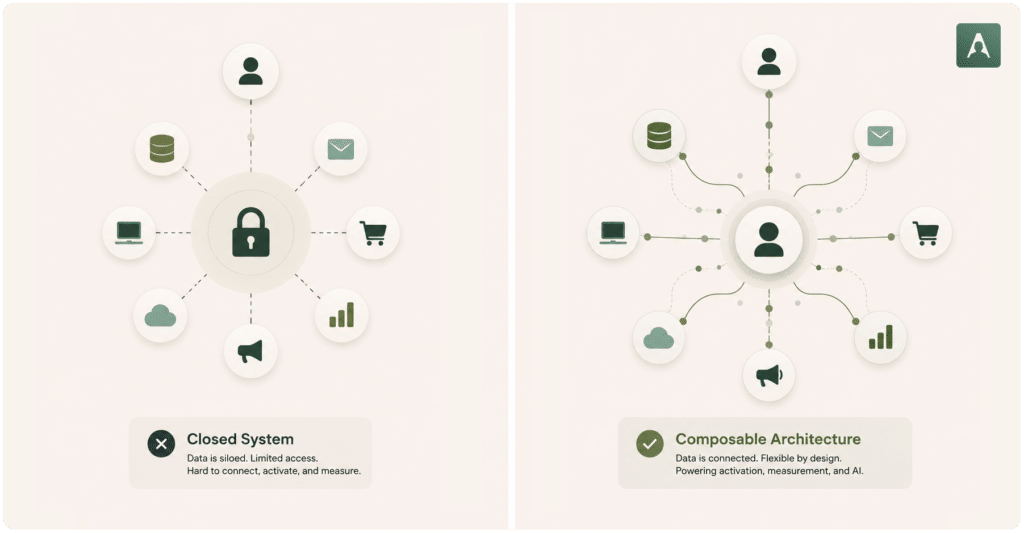
Composable architecture allows organizations to build their marketing and data stack using flexible, interoperable components instead of relying on one closed system to do everything.
Every enterprise has a different data environment. Some are heavily invested in cloud data warehouses. Others rely on a mix of CRM, CDP, analytics, clean room, media, and agency systems. Many operate across multiple platforms, partners, and channels at the same time.
A closed system may offer convenience, but it can limit flexibility. Composable infrastructure gives brands more control over how data is connected, enriched, activated, and measured. It supports best-in-class tools without forcing every workflow into one proprietary environment.
For marketers, that flexibility is becoming essential. Campaigns are more complex. Customer journeys are fragmented. Measurement is harder. Data collaboration is more important. AI is increasing the demand for accurate, connected, and context-rich customer data.
Interoperability Gives Marketers More Control
Interoperability is what makes composable infrastructure useful.
It is not enough for customer data to sit inside a warehouse, platform, or application. Marketers need that data to support planning, activation, measurement, and optimization across the systems where work actually happens.
Interoperable workflows allow identity resolution to support audience creation, enriched customer profiles to inform segmentation, activation to happen across platforms and channels, and measurement to connect back to a more complete customer view.
This gives marketers more control over the context behind every campaign. Performance is shaped by the quality of the audience, the accuracy of the identity layer, the richness of the customer profile, the activation pathway, and the ability to measure outcomes clearly.
When workflows are disconnected, marketers lose visibility. When they are interoperable, marketers gain a stronger foundation for decision-making.
Identity Infrastructure is Central to Composability
Identity infrastructure plays a critical role in composable customer infrastructure because it connects data across systems.
Without identity resolution, customer data remains fragmented. A single customer may appear as multiple records across channels, devices, transactions, forms, and engagement points. That limits how effectively marketers can build audiences, personalize campaigns, measure performance, and understand customer behavior.
Identity creates a more unified and accurate customer view that can support enrichment, profiling, activation, measurement, attribution, and analytics.
In a composable architecture, identity should not be trapped inside one platform or limited to one activation pathway. It should support data movement across the environments where marketers need to use it.
That is why neutral, interoperable identity infrastructure is so important. It helps customer intelligence move across the stack without creating unnecessary dependency on one closed ecosystem.
Why This Matters for AI-Ready Marketing
AI adds urgency to composability because AI-driven workflows need customer intelligence that can move across systems, not sit in isolated platforms. The more brands use AI across planning, activation, measurement, and optimization, the more important flexible, interoperable infrastructure becomes.
Where Hightouch and Audience Acuity Fit
The shift toward composable customer infrastructure is also why ecosystem partnerships matter.
Hightouch and Audience Acuity reflect the move toward flexible architecture and interoperable data workflows that give marketers more control over the data and context behind every campaign.
Hightouch helps brands activate data from their existing environments across the tools and platforms where marketing happens. Audience Acuity helps strengthen the identity foundation through identity resolution, enrichment, profiling, activation, measurement, and attribution.
Together, this approach supports a more flexible customer data strategy. The value is not just in connecting systems. It is in helping marketers use customer data more effectively across the full campaign lifecycle, with better audience intelligence, more flexible activation, stronger measurement, and more control over data workflows.
As the market moves toward more connected, AI-driven workflows, composable infrastructure is becoming the safer bet for brands that want control over their data and flexibility across ecosystems.
 AI-Ready Marketing Starts with Identity Infrastructure