


First-party data has become one of marketing’s most valuable assets. Brands have invested heavily in collecting, organizing, and protecting it — building loyalty programs, CRMs, data warehouses, and activation strategies around the idea that owning customer data gives them more control.
But ownership is not the same as control. A brand may own the data and still depend on someone else’s infrastructure to make that data usable.
As identity resolution, activation, measurement, and AI-readiness become more connected, brands need to ask a harder question: do we truly control our customer data strategy, or are we renting back access to the systems that make our own data valuable?
First-Party Data Is Only the Beginning
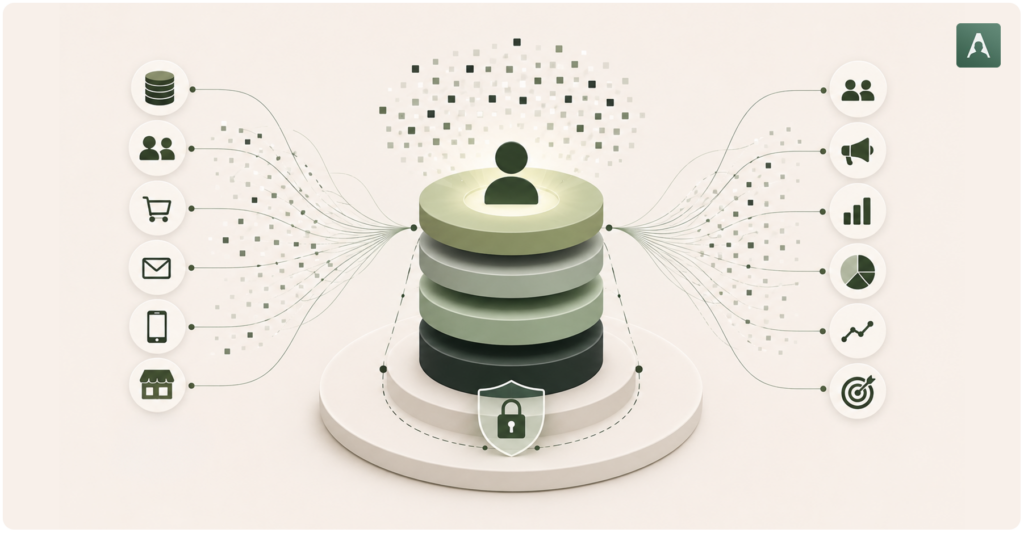
Customer data often lives across CRMs, websites, transaction systems, loyalty programs, email platforms, and data warehouses. Each system may hold valuable information — but if that data is disconnected, duplicated, or hard to activate, its value is limited.
Turning first-party data into usable customer intelligence requires identity resolution, enrichment, profiling, activation, measurement, and attribution — the ability to connect data across systems, partners, and channels accurately and responsibly.
First-party data does not create value on its own. It creates value when brands have the infrastructure to understand it, connect it, and use it.
Access Is Not Control
Many brands own their customer data but don’t fully control how it becomes useful.
Access means a brand can use a system. Control means the brand can decide how data moves, how identity is resolved, how audiences are built, and how customer intelligence is applied across environments.
Customer data strategies now span cloud environments, clean rooms, media platforms, retail media networks, publishers, and AI workflows. Brands need infrastructure that supports that complexity without forcing every decision into one closed system — infrastructure that lets them build their data strategy around business needs, not ecosystem limitations.
The Identity Layer Shapes the Strategy
Identity infrastructure is what connects fragmented records into a complete view of the customer, supporting audience development, activation, measurement, and attribution.
If identity is fragmented, the customer view is fragmented. If it’s tied too closely to one closed ecosystem, brands lose flexibility in how they use customer intelligence across channels and partners.
The right identity infrastructure strengthens a brand’s first-party data strategy instead of creating new dependency — it should be interoperable, work across ecosystems, and give marketers more control over the data behind every campaign.
The Risk of Renting Back Customer Intelligence
Some brands own their data but still rent access to the systems that make it valuable — relying on external platforms to resolve identity, depending on closed environments for activation, or receiving measurement without full transparency.
That can create short-term convenience but limit long-term flexibility. It doesn’t mean every workflow needs to be owned internally — it means the infrastructure should support the brand’s strategy, not limit it.
Customer Data Control Is the Advantage
The future of first-party data strategy isn’t only about collecting more data — it’s about controlling how that data becomes useful.
Audience Acuity helps organizations strengthen that foundation through identity resolution, enrichment, profiling, activation, measurement, and attribution — infrastructure built to be accurate, interoperable, and ready for how modern marketing, and AI-driven workflows, actually work.
Owning customer data is only the beginning. The real advantage comes from owning the strategy and infrastructure that make it valuable.
 Composable Customer Infrastructure is Becoming the Safer Bet